
 Blog · RE-MIND
Seven Attitudes of Mindfulness in The Museums
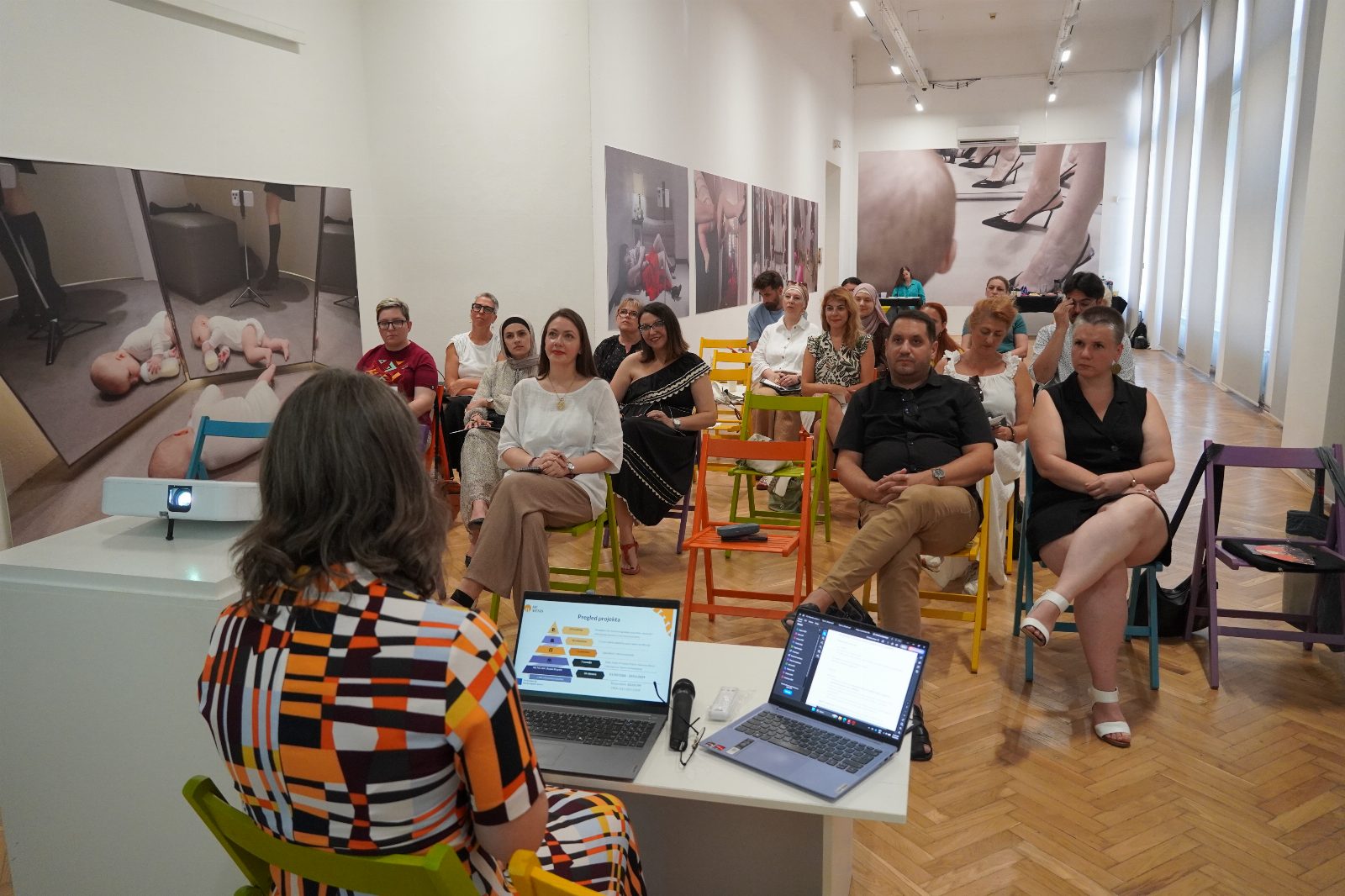
How long do we spend with a painting? In a study at the Metropolitan Museum of Art, Smith and Smith (2001) observed 150 visitors looking at six paintings. The median viewing time was 17 seconds. That finding belongs to a particular study, but it raises a useful question for any museum visit: what might we notice if we stayed a little longer?
Mindfulness involves deliberately attending to present experience with openness towards what arises (Kabat-Zinn, 1994). In Full Catastrophe Living, Kabat-Zinn (2013) describes seven attitudes that support this practice. The museum examples below are our application of those attitudes to encounters with art.
Non-Judgment
Notice an initial reaction without allowing it to decide the whole encounter. You might find yourself thinking, “I don’t get modern art.” Recognising that thought gives you a chance to look again. What colours hold your attention? Where does a line lead? You can explore the work while still acknowledging that you do not particularly like it.
Patience
Give an experience time to develop without demanding an immediate result. A painting may offer little at first glance, then draw your attention to a detail you had missed. Staying for a few minutes allows that possibility. There is no ideal viewing time to achieve; the invitation is to let your encounter develop at a comfortable pace.
Beginner’s Mind
Approach the familiar with enough curiosity to discover something unexpected. Even a painting you know from reproductions may look different in the gallery: its scale, surface or relationship to neighbouring works can surprise you. Museum staff can try this with an object they pass every day, asking what they have stopped noticing through familiarity.
Trust
Treat your own sensations and responses as a legitimate starting point. Before reaching for an explanation, you might notice where your eyes settle or whether the work leaves you feeling at ease. Labels and expert accounts can deepen understanding. Trust means giving your own response room alongside them, without assuming that it must match somebody else’s.
Non-Striving
Ease the pressure to produce a particular feeling or insight. A museum visit can become another task when you feel obliged to see every room, understand every work or leave feeling relaxed. For a while, allow yourself simply to look. Your emotional response does not need to meet a standard, and an ordinary encounter need not be turned into a profound one.
Acceptance
Acknowledge the response you are having, even when it differs from what you hoped for. You may feel interested, bored or unsettled by a work. Recognising this can help you decide whether to stay, look differently or move on. Acceptance does not require approval of a work’s message, nor does it oblige you to remain in a situation that feels uncomfortable.
Letting Go
Allow thoughts and feelings to change without holding on to them or forcing them away. In front of a painting, your mind may drift to an unfinished email. Once you notice, you can return to a detail in the work. The same applies to a pleasing moment: it can be appreciated without expecting the rest of the visit to reproduce it.
Room to Breathe at Manchester Art Gallery
Room to Breathe offers a practical example of a space designed to encourage slower encounters with art. Developed through work involving museum and wellbeing consultant Louise Thompson and senior curator Fiona Corridan, it has a domestic feel, with seating, dark walls and a small selection of paintings. In the display described by Goldsmiths, artworks were presented without adjacent labels (Burakowski, 2025).
These choices can be interpreted through Kabat-Zinn’s attitudes. Seating may make patience easier to practise, while a smaller display may reduce the pressure to see everything. An initial encounter without a label may invite personal observation and a fresh perspective. These connections are our interpretation, rather than evidence that the space was designed around, or tested against, all seven attitudes. For other museums, interpretation should remain available in forms that meet visitors’ needs.
Igdalova, Humphries and Chamberlain (2025) examined mindful breathing and gallery design in two experiments. In the first, involving 202 participants in Room to Breathe, a brief mindful breathing video had no statistically significant effect on mood or aesthetic experience. A second experiment in a conventional gallery enabled comparison between settings. Visitors in Room to Breathe reported more pleasant feelings, lower arousal, greater engagement with visual features and longer viewing times than those in the conventional setting.
The findings suggest that the setting deserves attention when museums plan mindful viewing activities. They do not establish which individual design feature produced the differences, or demonstrate lasting improvements in mental health. The absence of a significant effect for this particular breathing exercise also does not establish that breathing practices are ineffective more generally.
Try It on Your Next Visit
Choose one work and find a comfortable place to pause. If it suits you, spend a few minutes looking before reading the label. Notice a detail, your response to it and any urge to move on. When your attention wanders, gently return to the work. Read further or leave when you are ready.
Sources
- Burakowski, K. (2025, February 25). Gallery project shows how viewing art can boost wellbeing. Goldsmiths, University of London. https://www.gold.ac.uk/news/2025/room-to-breathe/
- Igdalova, A., Humphries, S., & Chamberlain, R. (2025). Room to breathe: Testing the efficacy of mindful breathing and mindful design in enhancing museum experiences. The Journal of Positive Psychology, 20(6), 932–949. https://doi.org/10.1080/17439760.2025.2502489
- Kabat-Zinn, J. (1994). Wherever you go, there you are: Mindfulness meditation in everyday life. Hyperion.
- Kabat-Zinn, J. (2013). Full catastrophe living: Using the wisdom of your body and mind to face stress, pain, and illness (Rev. ed.). Bantam Books.
- Smith, J. K., & Smith, L. F. (2001). Spending time on art. Empirical Studies of the Arts, 19(2), 229–236. https://doi.org/10.2190/5MQM-59JH-X21R-JN5J